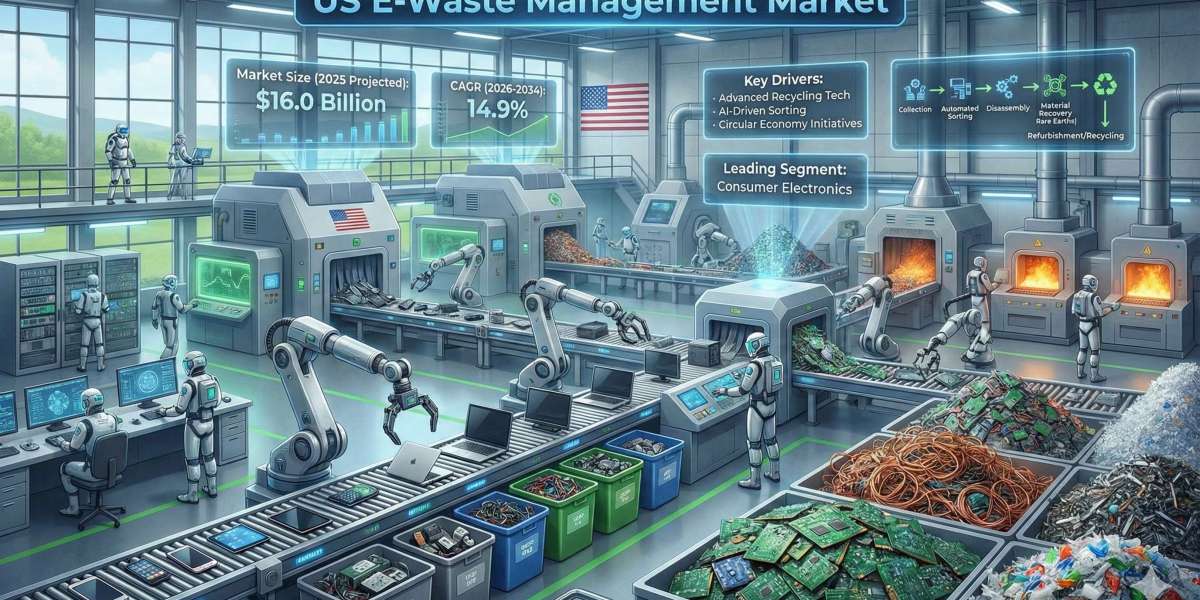

The Global Us E Waste Management Market is witnessing rapid evolution driven by soaring electronic consumption, early product obsolescence, and rising consumer awareness regarding responsible disposal of discarded devices. Across both residential and commercial environments, electronic equipment upgrades have become frequent, resulting in substantial volumes of end-of-life products.
This has created a strong need for organized waste collection, recycling, secure data destruction, and refurbishment operations. Growing sustainability commitments, material recovery requirements, and government regulations are further propelling the industry’s development, while the shift toward a circular economy is encouraging businesses to prioritize resource efficiency and reuse over traditional landfill disposal.
Market Overview
The US E Waste Management Market is projected to reach USD 16.0 billion in 2025 and is anticipated to expand at a notable CAGR of 14.9% from 2025 to 2034, ultimately achieving a valuation of USD 56.0 billion. This growth trajectory reflects the rising disposal of smartphones, computers, home appliances, networking solutions, medical electronics, and industrial control systems. The increase in technology adoption across households, enterprises, and manufacturing greatly accelerates device turnover, pushing demand for scalable recycling and dismantling services.
Modern e-waste processors increasingly utilize cutting-edge solutions such as automated material separation, precise metal extraction technologies, robotics-based dismantling, and AI-driven device recognition. In addition, secure data destruction has become an integral component of electronic disposal, especially across IT, healthcare, finance, and enterprise sectors, where device retirement must comply with strict privacy and cybersecurity protocols. Meanwhile, extended producer responsibility (EPR), take-back programs, and buyback initiatives are driving consumer participation and contributing to the market’s momentum.
Market Dynamics
Growth of the US E Waste Management Market is shaped by evolving product lifecycles, regulatory interventions, and technological breakthroughs. The decreasing lifespan of modern electronics is a primary growth driver. With frequent system upgrades and rapid product innovation, consumers and businesses replace devices much more often than past decades, intensifying e-waste accumulation and creating opportunities for recycling providers.
Government regulations mandating safe disposal of electronics also play a decisive role. Restrictions on landfill dumping of hazardous components and compliance frameworks for safe handling support the expansion of certified recyclers. With increasing public awareness of toxins such as cadmium, lead, and mercury within electronic waste, local municipalities and statewide environmental programs continue to emphasize structured collection and disposal.
However, the market also faces challenges including inconsistent consumer disposal patterns, limited access to recycling facilities in underserved areas, and the technical complexity of recovering valuable materials from mixed electronic components. Still, the market landscape is rapidly improving due to automation, innovations in urban and rural collection logistics, and improved recovery yields for precious and rare earth metals.
An emerging growth area lies in refurbished electronics, where professionally restored devices are resold for business and consumer use. The model supports affordability and sustainability and significantly reduces landfill waste. Expanding refurbishing facilities and certification standards are helping build trust in restored devices and stimulating this segment of the market.
Regional Analysis
The US E Waste Management Market features a highly diverse and competitive landscape including national recycling corporations, established regional facilities, and specialists serving consumer electronics, industrial hardware, or enterprise-level equipment. Urban regions—particularly California, New York, Illinois, and Texas—represent the highest e-waste generation due to strong digital adoption among enterprises and consumers. These states also exhibit strong regulatory backing for recycling and host large networks of certified disposal centers.
Industrial regions across the Midwest and Southeast show rising demand due to modernization of manufacturing systems, industrial automation, and replacement of legacy equipment. In these zones, secure data destruction and commercial refurbishment services are increasingly adopted to support compliance and cost optimization. This demand is helping local recycling and refurbishing operations scale up their infrastructure.
Meanwhile, suburban and rural areas rely heavily on community-driven programs including donation drives, recycling drop-off services, electronics pickup programs, and environmentally focused awareness campaigns. Schools, universities, public institutions, and government facilities also play an active role by upgrading infrastructure and creating significant e-waste inflows on a recurring basis. Taken together, these factors highlight a robust national momentum supported by policy, sustainability initiatives, and digitization.
Download a Complimentary PDF Sample Report : https://dimensionmarketresearch.com/report/us-e-waste-management-market/request-sample/
FAQs
1. What is the main factor accelerating demand in the US E Waste Management Market?
The increasing volume of discarded electronics caused by frequent device upgrades and rapid digital adoption is the key factor expanding the demand for waste management and recycling services.
2. Which product categories contribute most to e-waste?
Smartphones, laptops, household appliances, IT networking hardware, and industrial electronics contribute substantially due to their large customer base and short replacement cycles.
3. Why is secure data destruction important in e-waste?
Devices often store sensitive information even after deletion, so certified destruction prevents unauthorized access and ensures compliance with privacy and security standards.
4. Are refurbished electronics influencing market growth?
Yes, refurbished electronics have become increasingly popular because they offer sustainability benefits and cost savings, boosting demand for qualified refurbishment services.
5. How is technology transforming e-waste processing?
Automation, AI-enabled sorting, robotic dismantling, metal recovery technologies, and blockchain-based traceability are improving processing speed, resource extraction accuracy, and environmental performance.
Summary of Key Insights
The US E Waste Management Market is undergoing strong expansion supported by environmental awareness, digitalization across industries, and regulatory efforts restricting hazardous disposal. With the market projected to grow from USD 16.0 billion in 2025 to USD 56.0 billion by 2034 at a CAGR of 14.9%, opportunities continue to emerge across recycling, data destruction, refurbishment, and material recovery. The integration of AI and automation, expanded regional collection networks, and the rise of sustainable electronics purchasing habits will remain central to market progress. Providers prioritizing scalability, compliance, and technological innovation are expected to benefit most from the rapidly accelerating shift toward circular economy models.
Purchase the report for comprehensive details : https://dimensionmarketresearch.com/checkout/us-e-waste-management-market/