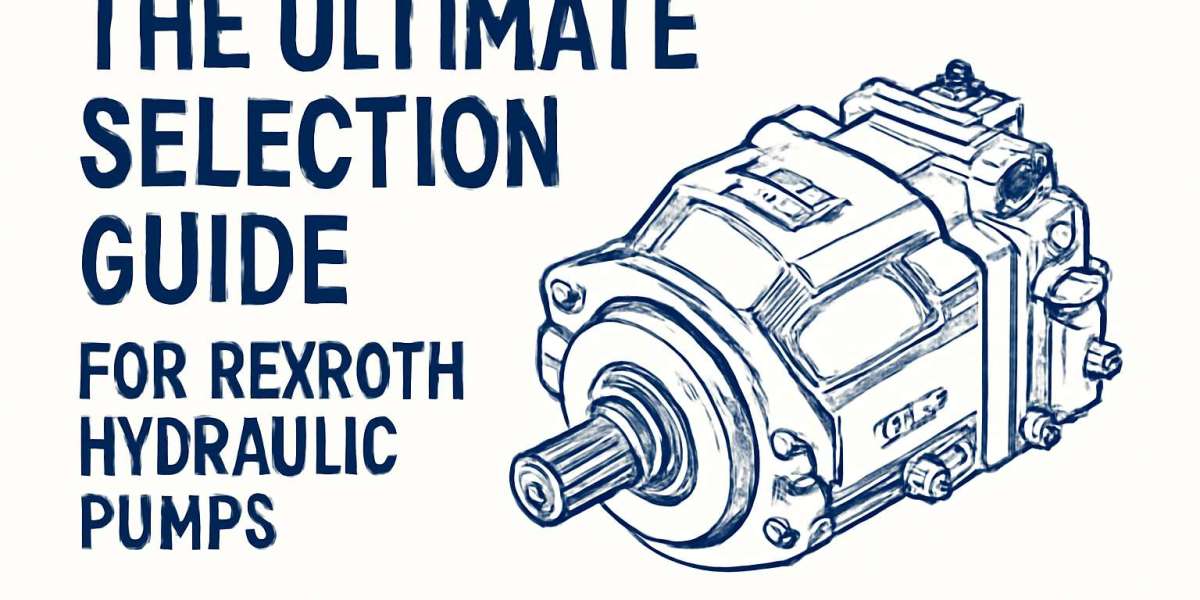

When you think of reliability, versatility, and industrial‑grade performance, Rexroth hydraulic pumps stand among the top choices worldwide. But choosing the right pump from their wide product range requires thoughtful evaluation of several technical and practical factors. This guide walks you through how to select the correct Rexroth hydraulic pump for your needs — whether for heavy machinery, manufacturing systems, marine use, or general industrial applications.
? Why Rexroth Hydraulic Pumps?
Rexroth hydraulic pumps are designed for demanding environments: high pressure, varying flow rates, continuous operation, and diverse fluid types. Their pumps — from gear and vane to piston and radial‑piston designs — serve industries from construction and agriculture to marine, automotive, and manufacturing.
Because of this, Rexroth pumps are highly regarded for performance, longevity, and flexibility across different hydraulic systems.
Types of Rexroth Pumps — And When to Use Each
Rexroth offers multiple pump types. Choosing the right type depends largely on what your system demands.
Gear Pumps — Often used for low‑ to medium‑pressure applications. They operate with fixed displacement and provide a steady, constant flow per revolution. Gear pumps are simple, cost‑effective, and good for lubrication, circulation, or auxiliary hydraulic circuits.
Vane Pumps — Suitable for medium pressures and offer quieter operation and smooth flow. They are ideal when noise reduction and stability are priorities.
Axial Piston Pumps (Fixed or Variable Displacement) — Very popular in Rexroth’s portfolio. These pumps handle medium to high pressures and can provide variable flow rates if variable‑displacement versions are chosen. They are excellent for heavy‑duty machinery, mobile hydraulics (like construction equipment), and industrial systems requiring high power density.
Radial Piston Pumps — Designed for high pressures (some up to 700 bar), these pumps are used when extremely high pressure and robust performance are needed.
Key Selection Criteria
When selecting Rexroth hydraulic pumps, consider the following factors carefully:
Flow Rate and Pressure Requirements
Determine the required flow (volume per minute or hour) and operating pressure of your hydraulic system. High-pressure, high-load systems typically demand piston or radial‑piston pumps. Lower-pressure systems with simpler demands may get by with gear or vane pumps.
Type of Hydraulic Circuit
Decide whether your system uses an open-loop or closed-loop hydraulic circuit. This influences which pump types are compatible and how the pump’s displacement or controls need to be configured.
Fluid Type and Viscosity
The type of hydraulic fluid (mineral oil, water‑based, synthetic, etc.) and its viscosity affect pump choice. Some pumps perform better with low-viscosity fluids; others are more tolerant.
Noise, Efficiency, and Maintenance
If noise is a concern (for example, in indoor or marine applications), vane or gear pumps may be preferable. For maximum efficiency and long service life, piston or radial‑piston pumps often offer better performance.
Application & Environment
Consider where the pump will operate: heavy machinery, marine environments, industrial plants, or mobile equipment. For example, marine hydraulics often prioritize compact, high‑pressure, low‑noise solutions.
Displacement Type: Fixed vs. Variable
Fixed‑displacement pumps deliver a consistent flow, while variable‑displacement pumps let you adjust flow dynamically — useful when load requirements change frequently.
Examples of Rexroth Hydraulic Pumps
Here are some real-world examples of Rexroth pumps used widely across industries:
Bosch Rexroth Hydraulic Gear Pump — A gear pump that offers steady flow for low- to medium-pressure tasks, ideal for lubrication and auxiliary hydraulic circuits or simpler hydraulics.
Rexroth A10VO Hydraulic Pump — An axial piston pump suitable for medium- to high-pressure applications, especially where variable displacement and controlled flow are needed for heavier workloads.
Depending on your system demands, flow requirements, and pressure expectations, these pumps demonstrate how varied the Rexroth lineup is — and how important it is to choose thoughtfully.
Pros & Cons — What to Watch Out For
Pros:
Multiple pump types cover a wide range of applications (from low‑pressure brushes to heavy‑duty industrial systems).
High reliability, long service life, and broad compatibility with hydraulic fluids.
Availability of variable displacement for flexible flow control and energy efficiency.
Cons:
Over-specifying (e.g., using a high-pressure axial piston pump for a low-pressure need) can be unnecessarily expensive and inefficient.
Some pump types (gear, vane) may not deliver high pressure needed for heavy-duty operations.
Maintenance and fluid compatibility must be handled carefully to ensure longevity — wrong fluid, or poor maintenance, can reduce performance over time.
✅ Quick Checklist Before Finalizing Your Pump Choice
✅ Have you clearly defined required flow rate and pressure?
✅ Is your hydraulic circuit open‑loop or closed‑loop?
✅ What type of fluid (and viscosity) will you use?
✅ Do you need constant flow or variable flow?
✅ Is noise/efficiency/maintenance a concern in your application?
✅ Does your application environment (e.g. marine, heavy machinery, industrial plant) demand special features like high pressure or compact design?