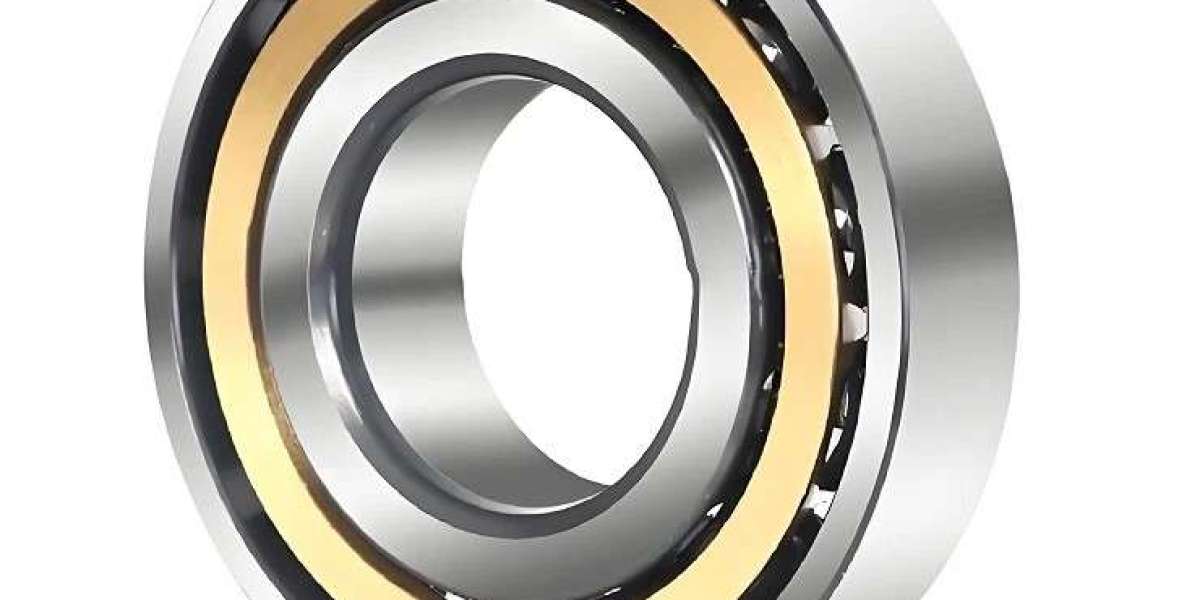

What is an Angular Contact Ball Bearing?
An Angular Contact Ball Bearing is a type of rolling-element bearing designed to support both radial and axial loads. Unlike standard deep groove ball bearings, angular contact bearings have raceways that are offset at an angle relative to the bearing axis. This angle allows the bearing to accommodate higher axial loads in one direction, while still handling radial loads efficiently.
Key characteristics of Angular Contact Ball Bearings include:
Axial Load Support: Can carry significant axial loads alongside radial loads.
High-Speed Performance: Designed to operate effectively at high rotational speeds.
Rigidity: Offers precise rotational movement, making it ideal for applications requiring tight tolerances.
Alignment Sensitivity: Sensitive to misalignment; proper installation is crucial.
Because of these characteristics, Angular Contact Ball Bearings are widely used in industries such as automotive, aerospace, robotics, and industrial machinery.
Key Factors to Consider When Choosing an Angular Contact Ball Bearing
Selecting the right bearing involves more than picking a model number from a catalog. Several factors should influence your decision:
1. Load Requirements
Angular contact bearings are designed to handle both radial and axial loads, but the proportion of each can vary by application. Understanding your load requirements is crucial:
Radial Load: The load applied perpendicular to the shaft.
Axial Load: The load applied parallel to the shaft.
The contact angle of the bearing determines how much axial load it can accommodate. Common angles range from 15° to 40°, with higher angles supporting greater axial loads. For applications with heavy axial forces, a bearing with a larger contact angle is preferable.
2. Speed Limitations
Angular contact bearings are capable of high-speed operation, but speed limits depend on the type of lubrication, precision class, and bearing size. Key considerations include:
Dynamic Load Rating: Determines the bearing's capacity to withstand continuous motion.
Lubrication: Proper lubrication minimizes friction and heat buildup, allowing higher speeds.
Cage Material: Bearings with steel, brass, or polymer cages have different speed tolerances.
If your project involves high-speed rotation, selecting a bearing designed specifically for high-speed applications is essential.
3. Precision and Tolerance
The level of precision required varies depending on the application. For example:
General Machinery: Standard precision bearings may suffice.
High-Performance Machinery: CNC machines or robotics often require high-precision bearings to reduce vibration and improve accuracy.
Angular contact bearings are available in several precision classes, from P0 (standard) to P4 or P2 (high precision). Higher precision bearings are more expensive but offer better rotational accuracy and lower noise.
4. Mounting Configuration
Angular contact bearings can be mounted in various configurations to optimize performance:
Single Bearing: Supports loads in one direction; simplest configuration.
Back-to-Back (DB): Two bearings mounted with their wide ends facing outwards; provides rigidity and can handle axial loads in both directions.
Face-to-Face (DF): Two bearings with narrow ends facing outwards; accommodates slight misalignment.
Tandem (DT): Bearings arranged to handle high axial loads in one direction.
The choice of configuration affects load distribution, stiffness, and alignment sensitivity.
5. Bearing Material
While most Angular Contact Ball Bearings are made of high-quality steel, there are other material considerations:
Stainless Steel: Resistant to corrosion; ideal for humid or chemically aggressive environments.
Ceramic Hybrid: Combines steel rings with ceramic balls; lightweight, low friction, and suitable for very high-speed applications.
Special Alloys: Some applications may require bearings made from high-temperature alloys or other specialized materials.
Material selection impacts durability, heat resistance, and performance under specific conditions.
6. Lubrication
Proper lubrication is vital for the performance and longevity of an Angular Contact Ball Bearing. Options include:
Grease: Simple and effective for most applications; suitable for moderate speeds and loads.
Oil: Provides better cooling and is preferred for high-speed or high-temperature applications.
Solid Lubricants: For extreme conditions where conventional grease or oil fails.
Selecting the right lubrication depends on speed, load, and environmental conditions.
7. Environmental Considerations
The operating environment can significantly affect bearing life. Consider:
Temperature: Bearings have operating temperature ranges; extreme heat or cold may require special materials or lubrication.
Contamination: Dust, dirt, and chemicals can damage bearings. Seals or shields may be necessary.
Vibration and Shock Loads: High-impact conditions require bearings with robust construction.
Taking environmental factors into account ensures reliable performance and reduces maintenance costs.
Steps to Select the Right Angular Contact Ball Bearing
Determine Load Requirements
Calculate the expected radial and axial loads. Decide the required contact angle based on the axial load capacity.Consider Speed and Precision
Identify the operating speed and required accuracy. Choose a precision class that balances performance with cost.Choose the Mounting Configuration
Decide whether a single, back-to-back, face-to-face, or tandem arrangement suits your project’s load distribution and alignment tolerance.Select Material and Lubrication
Choose bearing materials and lubrication based on speed, environmental conditions, and chemical exposure.Check Size and Fit
Ensure the bearing dimensions match your shaft and housing. Consider tolerances for thermal expansion and alignment.Review Manufacturer Specifications
Consult manufacturer catalogs for dynamic and static load ratings, limiting speeds, and recommended applications.Test and Validate
If possible, test the bearing under actual operating conditions to verify performance before full-scale implementation.
Common Applications of Angular Contact Ball Bearings
Understanding typical applications helps in selecting the right bearing for your needs:
Machine Tools: High precision and rigidity are crucial for CNC machines and grinding machines.
Pumps and Compressors: Bearings handle both radial and axial loads under varying speeds.
Robotics: Require high-speed, low-friction bearings for smooth, precise movement.
Automotive: Used in transmissions, wheels, and engines where mixed loads are common.
Aerospace: Bearings must endure extreme loads, temperatures, and vibration while remaining lightweight.
Maintenance Tips for Angular Contact Ball Bearings
Even the best-selected bearing requires proper maintenance:
Regular Lubrication: Follow manufacturer recommendations for grease or oil intervals.
Monitor Temperature: Unusual heat may indicate overloading or insufficient lubrication.
Inspect for Wear: Look for pitting, corrosion, or unusual noise, which can signal the need for replacement.
Proper Installation: Avoid hammering or misalignment during assembly to prevent early failure.
Conclusion
Choosing the right Angular Contact Ball Bearing is a multi-faceted decision that can greatly influence the efficiency and longevity of your project. By carefully considering load requirements, speed, precision, mounting configuration, materials, lubrication, and environmental conditions, you can select a bearing that not only fits your mechanical design but also performs reliably under real-world operating conditions.
Remember, investing time in the correct bearing selection upfront will save time, costs, and potential downtime later. Whether for high-precision machinery, automotive applications, or industrial equipment, the right Angular Contact Ball Bearing is a cornerstone of mechanical success.