
Executive Summary
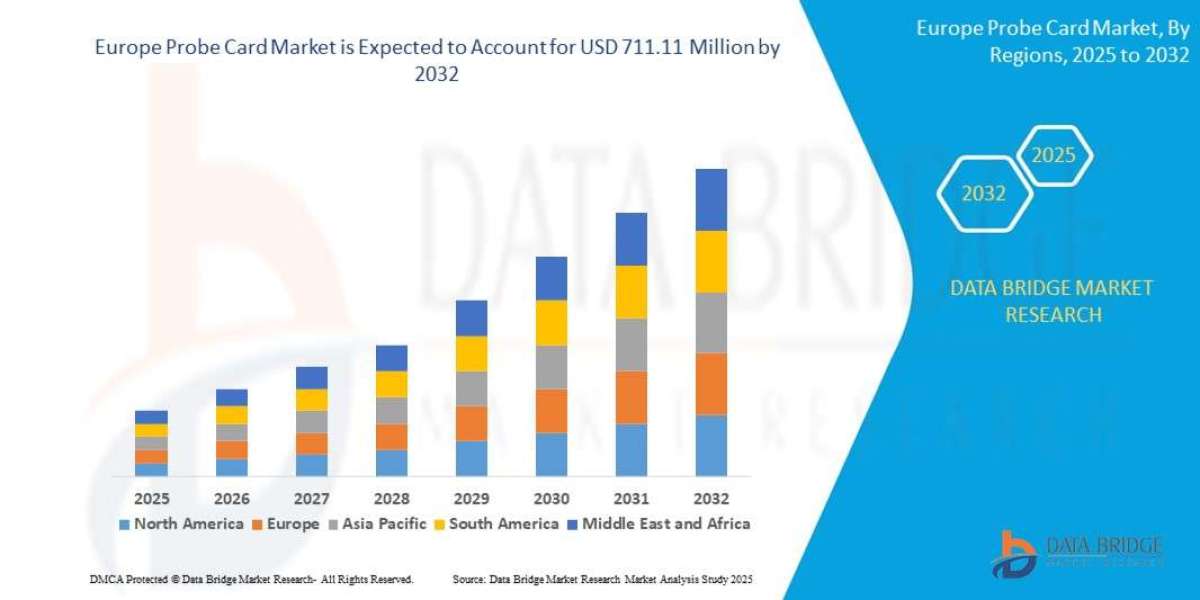
- The Europe probe card market size was valued at USD 324.59 million in 2024 and is expected to reach USD 711.11 million by 2032, at a CAGR of 10.30% during the forecast period
Market Overview
Defining the Probe Card Market
A probe card is an electromechanical interface that provides the electrical path between the automatic test equipment (ATE) and the ICs on a semiconductor wafer. Its primary function is to perform electrical wafer sorting (EWS)—testing the functionality and performance of the chips before they are diced and packaged.
Key Segments
The market is segmented along several axes crucial for strategic analysis:
| Segmentation Axis | Dominant/Fastest-Growing Segment in Europe | Key Drivers |
| Probe Type | Advanced Probe Cards (dominant share, incl. MEMS) | Testing for AI, 5G, HPC, and advanced logic/foundry nodes. |
| Technology | MEMS-based Probe Cards (largest share) | Requirement for fine-pitch capability, high-parallelism, and superior repeatability. |
| Wafer Size | More than 12 Inches (300mm) (dominant share) | Industry shift to larger wafers for cost-efficient, high-volume manufacturing. |
| Application | Foundry and Logic (largest segment) | Growth in high-performance computing (HPC) and complex SoC development. |
| End-Use | Automotive Electronics (fastest growth) | Electrification (EVs), Advanced Driver-Assistance Systems (ADAS), and autonomous driving. |
Market Drivers and Current Dynamics
The European Chips Act: This landmark legislative initiative, aiming to double Europe’s global market share in semiconductors to 20% by 2030, is the single most significant driver. It involves massive public and private investment, spurring the construction of new fabs and the expansion of existing facilities (e.g., in Germany and France), directly increasing the demand for advanced probe cards.
Automotive Electrification and ADAS: Europe is a global hub for the automotive industry. The transition to Electric Vehicles (EVs) and the proliferation of ADAS require robust testing for high-voltage and high-current power management ICs (SiC and GaN) and complex microprocessors, demanding specialized, high-reliability probe cards.
Miniaturization and Complexity: The continuous reduction in feature sizes (e.g., to 7nm, 5nm, and 3nm) and the move toward 3D-stacked ICs and chiplet-based systems necessitate probe cards with extremely fine pitch, high pin counts, and high-frequency/high-speed testing capabilities.
The 5G and IoT Rollout: The widespread adoption of 5G, IoT devices, and associated infrastructure drives demand for RF and mixed-signal test solutions, which require high-frequency probe cards to ensure signal integrity.
Market Size & Forecast
- The Europe probe card market size was valued at USD 324.59 million in 2024 and is expected to reach USD 711.11 million by 2032, at a CAGR of 10.30% during the forecast period
For More Information Visit https://www.databridgemarketresearch.com/reports/europe-probe-card-market
Key Trends & Innovations
1. Dominance of MEMS Technology
Micro-Electro-Mechanical Systems (MEMS) probe cards are the undisputed leader in European innovation. MEMS-based technology provides a scalable, repeatable, and high-precision contact solution necessary for testing fine-pitch pads on advanced logic and memory devices. The inherent design flexibility of MEMS allows for higher probe density and multi-site testing, which is crucial for reducing the cost of test (COT).
2. High-Frequency and High-Current Probing
RF/mmWave Testing: The proliferation of 5G, automotive radar, and wireless communication is driving the need for probe cards capable of handling extremely high frequencies (mmWave) while maintaining signal integrity. This requires specialized probe card designs and materials to minimize loss and crosstalk.
SiC and GaN Power Devices: For the rapidly growing EV and industrial power markets, the focus is on high-current and high-voltage probe cards to reliably test Silicon Carbide (SiC) and Gallium Nitride (GaN) power devices, demanding enhanced arcing control and thermal stability.
3. Integration of AI and Automation in Testing
Manufacturers are increasingly exploring the integration of Artificial Intelligence (AI) and Machine Learning (ML) into the testing process. This includes:
Predictive Maintenance: AI algorithms analyze test data to predict probe tip wear, optimizing maintenance cycles and maximizing probe card lifespan.
Test Optimization: ML is used to refine test parameters and sequences for maximum efficiency and yield, especially for complex System-on-Chips (SoCs).
4. Shift Towards Wafer-Level Reliability (WLR) and KGD Testing
The emergence of chiplet architectures and advanced packaging (2.5D/3D-IC) is increasing the demand for wafer-level testing, including the testing of known good die (KGD) before final assembly. This necessitates probe cards capable of prolonged, high-temperature testing stress and precise contact across large die arrays.
Competitive Landscape
The European probe card market is highly competitive, dominated by a mix of global leaders with strong European operations and highly specialized local firms.
Major Players and Market Strategies
| Company (Global/European Focus) | HQ (Focus) | European Presence & Strategy | Key Product Focus |
| FormFactor Inc. | US (Global Leader) | Strong direct presence and sales channels across Europe, engaging with major fabs. | MEMS Probe Cards, High-performance parametric and memory test solutions. |
| Technoprobe S.p.A. | Italy (European Leader) | A key European-based competitor, focusing on vertical integration and localized R&D. | Vertical MEMS Probe Cards, High Pin Count (HPC) solutions for logic/foundry. |
| Micronics Japan (MJC) | Japan (Global) | Supplies major European IDMs and foundries, leveraging global semiconductor cycle. | Vertical and Cantilever Probe Cards, focus on memory (DRAM/Flash). |
| FEINMETALL GmbH | Germany (Specialist) | A crucial European-based player, known for high-quality, specialized solutions. | Cantilever and Vertical Probe Cards, specialty applications (e.g., power, RF). |
| MPI Corporation | Taiwan (Global) | Expanding European footprint, focusing on high-growth segments like RF and photonics. | Cantilever and Advanced Probe Cards, particularly for 5G/mmWave testing. |
Competitive Dynamics
Competition is less about price and more about technological differentiation and time-to-market. Key competitive strategies include:
Localized R&D and Manufacturing: Players like Technoprobe and FEINMETALL benefit from their proximity to European customers, offering faster response times and customized engineering solutions, which is vital given the short product lifecycle of probe cards.
Strategic Alliances: Partnerships between probe card manufacturers and test equipment providers (ATE vendors) or key European foundries are essential for co-developing next-generation solutions.
Focus on High-Margin, Advanced Segments: The European market’s shift towards high-value, advanced process nodes for automotive and logic (e.g., 7nm and below) pushes competition toward MEMS and other advanced vertical technologies, where the entry barriers (patents, R&D cost) are significantly higher.
Regional Insights
The European market is highly concentrated, with a few nations dominating semiconductor manufacturing and R&D activities:
Germany (Dominant Market): Germany holds the largest revenue share, supported by its strong semiconductor manufacturing base, world-leading automotive electronics industry, and a robust ecosystem for testing and metrology (e.g., Dresden’s Silicon Saxony cluster).
France (High Growth Potential): France is projected to witness the highest CAGR, largely fueled by significant state and EU investments under the European Chips Act, targeting domestic chip manufacturing and advanced R&D.
Italy (Key Player): Home to Technoprobe, Italy maintains a strong position, particularly in the manufacturing of high-end vertical probe cards for global logic and memory clients.
Benelux and Nordics: These regions show steady growth, primarily driven by specialized R&D in areas like advanced materials, photonics, and quantum computing, which require niche, ultra-low-temperature, and low-leakage probe solutions.
Challenges & Risks
1. High Capital Expenditure and R&D Costs
The development of advanced probe cards, particularly complex MEMS designs for sub-7nm nodes, requires immense capital investment in highly specialized manufacturing equipment and materials. This high barrier to entry limits the number of effective competitors and can be a financial strain, given the rapid obsolescence cycle.
2. Technological Complexity and Short Lifecycles
The relentless pace of semiconductor technology means probe card designs must constantly evolve to keep up with smaller feature sizes, higher I/O pin counts, and increased testing speeds. Failure to adapt quickly to new wafer technology or chip designs can render existing probe card inventory obsolete, posing a significant inventory risk.
3. Geopolitical and Supply Chain Dependence
Despite the push for regional independence via the Chips Act, Europe remains reliant on global suppliers (primarily Asia-Pacific) for key probe card components, specialized raw materials, and high-end manufacturing processes. Geopolitical instability can disrupt this supply chain, impacting time-to-market and costs for European manufacturers.
Opportunities & Strategic Recommendations
Opportunities
Exploitation of the EU Chips Act Momentum: The €43 billion Chips Act is creating a guaranteed demand for testing solutions in new European fabs. This is a once-in-a-generation opportunity for probe card manufacturers to establish long-term supply agreements and secure preferential funding/subsidies for localized capacity expansion.
Specialization in Automotive & Power IC Testing: Given Europe’s automotive dominance, there is a distinct, high-growth niche for manufacturers that can master the specialized requirements of SiC/GaN power devices, RF, and mission-critical ADAS/autonomous driving microprocessors.
Advanced Packaging & 3D-IC Focus: As European R&D shifts to advanced packaging (2.5D/3D-IC), the demand for KGD and wafer-level burn-in (WLBI) probe cards will surge, offering a premium segment opportunity.
Strategic Recommendations
| Stakeholder Group | Strategic Recommendation | Rationale |
| Probe Card Manufacturers | Invest in Co-Development with European IDMs/Foundries. | Deep, early-stage collaboration ensures probe card designs are optimized for the latest European process nodes, securing long-term contracts and competitive advantage. |
| Investors & VCs | Target MEMS and RF/Power Probe Card Specialists. | These segments align with Europe's strategic focus (Chips Act, automotive electrification) and offer the highest long-term growth and margin potential. |
| Startups/New Entrants | Focus on Niche Technology and Materials Science. | Avoid competing directly with global giants. Instead, specialize in unique areas like advanced materials for probe tips (e.g., enhanced durability) or cryogenic probing for quantum computing applications. |
| End-Users (European Fabs) | Standardize on Modular Probe Card Architectures. | Adopting modular systems (e.g., field-reconfigurable designs) can lower the total cost of ownership (TCO), shorten engineering change cycles, and mitigate the risk of rapid obsolescence. |
Browse More Reports:
Global Algae Fertilizers Market
Global Construction Film Market
Global Antimicrobial Agent Market
Global Benchtop Laboratory Water Purifier Market
Asia-Pacific Feed Flavours and Sweeteners Market
Global Catenary Infrastructure Market
Global Bus Public Transport Market
Latin America Point of Care Infectious Disease Market
Global Innovation Management Market
Middle East and Africa Indium Market
Global Antibiotics Market
Global Potassium Humate Biostimulants Market
Africa MDI, TDI, Polyurethane Market
Global Dental Diode Lasers Market
Middle East and Africa Artificial Turf Market
Global Hematologic Malignancies Market
Latin America Ostomy Devices Market
Asia-Pacific Rotomolding Market
Philippines Microgrid Market
Global Automated Beverage Carton Packaging Machinery Market
Global Surgical Power Tools Market
Europe Intensive Care Unit (ICU) Ventilators Market
Global Vasodilators Market
Global Methylene Diphenyl Diisocyanate (MDI), Toluene Diisocyanate (TDI) and Polyurethane Market
Global Constrictive Pericarditis Market
Middle East and Africa q-PCR Reagents Market
Global Artificial Turf Market
Global Styrene Butadiene Latex Market
Global Digital Farming Software Market
Global Alpha Linolenic Acid Market
Global Head and Neck Cancer Drug Market
About Data Bridge Market Research:
An absolute way to forecast what the future holds is to comprehend the trend today!
Data Bridge Market Research set forth itself as an unconventional and neoteric market research and consulting firm with an unparalleled level of resilience and integrated approaches. We are determined to unearth the best market opportunities and foster efficient information for your business to thrive in the market. Data Bridge endeavors to provide appropriate solutions to the complex business challenges and initiates an effortless decision-making process. Data Bridge is an aftermath of sheer wisdom and experience which was formulated and framed in the year 2015 in Pune.
Contact Us:
Data Bridge Market Research
US: +1 614 591 3140
UK: +44 845 154 9652
APAC : +653 1251 975
Email:- corporatesales@databridgemarketresearch.com