
Bringing a food idea to life is exciting, but the path from concept to commercialization is often more complex than many businesses expect. Food product development requires technical know-how, market insight, and regulatory compliance. Without the right support, even a promising idea can fail. That’s where Food Research Lab comes in — mitigating risk and guiding brands safely through the development process.
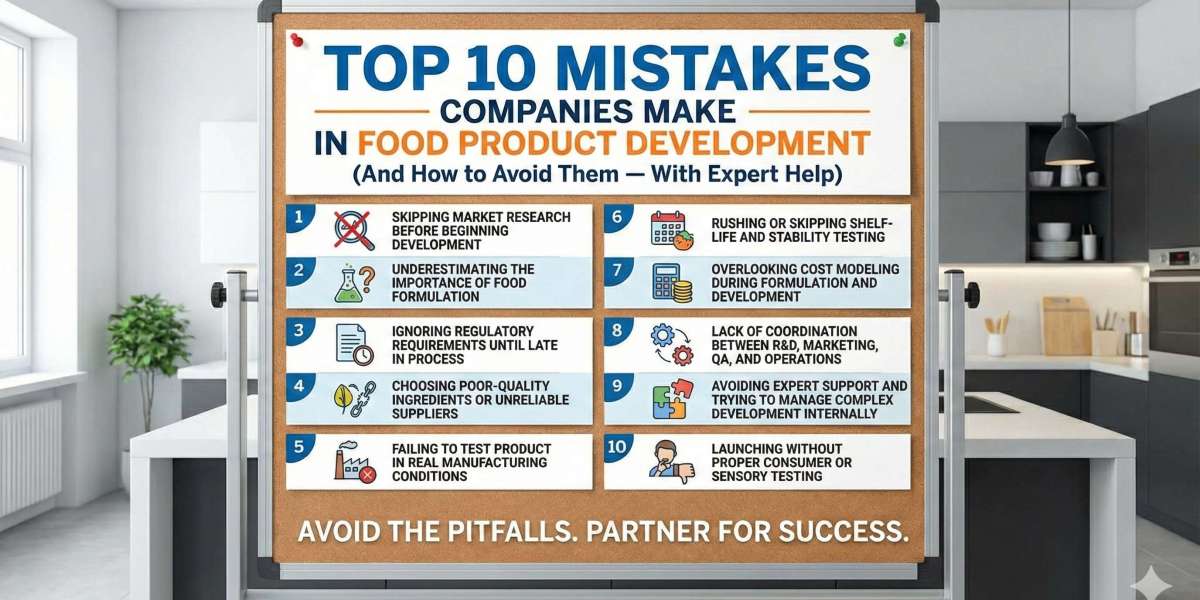
1. Skipping Market Research
Mistake: Many companies focus on what they think is good rather than what the market demands. Launching without understanding consumer preferences or competitive products can lead to failure.
How FRL Helps: As part of its new food product development services, Food Research Lab begins with market research, consumer behaviour studies, competitive benchmarking, and feasibility analysis — ensuring ideas are market-validated before formulation begins.
2. Underestimating the Role of Food Formulation
Mistake: Poor ingredient balancing can cause unstable texture, off-flavors, poor nutritional profile, or inconsistent performance when scaling up.
How FRL Helps: FRL brings together a cross-functional team of formulation scientists, technologists, nutritionists, and regulatory experts to deliver rigorous food formulation. Their lab-scale trials and optimization ensure the formulation is stable, appealing, and scalable.
3. Ignoring Regulatory Requirements Early
Mistake: Many brands forget about labeling rules, safety regulations, allergen declarations, and compliance until late — resulting in delays or costly reformulations.
How FRL Helps: Regulatory compliance is built in from day one. FRL supports certification and compliance with global regulatory regimes (such as FSSAI, USFDA, EFSA), handles regulatory documentation, label claims, nutritional panels, allergen declarations, and ensures regulatory‐ready formulations.
4. Choosing the Wrong Ingredients or Suppliers
Mistake: Selecting ingredients solely based on cost — or using unverified suppliers — can lead to inconsistency in quality, flavor, and safety.
How FRL Helps: FRL conducts ingredient sourcing, supplier vetting, quality assurance checks, certificate-of-analysis verification, and uses only high-quality, compliant ingredients, reducing risk of supply-chain variability.
5. Not Testing the Product in Real Manufacturing Conditions
Mistake: A recipe might work in a small test kitchen, but production-scale equipment and processes often behave differently — causing texture, stability or yield issues.
How FRL Helps: Their services include pilot-scale manufacturing trials that simulate commercial production conditions, helping validate the feasibility and scalability of the product before full-scale launch.
6. Rushing the Shelf-Life / Stability Process
Mistake: Skipping or shortening stability testing can result in products spoiling faster than expected — leading to quality issues and recalls.
How FRL Helps: FRL offers both accelerated and real-time stability testing, in line with industry guidelines (for example ICH), plus sensory evaluation over time to ensure shelf-life and quality remain consistent.
7. Overlooking Cost Modeling During Development
Mistake: Some products seem great on paper — but the final cost of goods is too high for the intended price point, making them commercially unviable.
How FRL Helps: Their development process includes ingredient sourcing, cost-analysis, and optimization — helping you strike a balance between quality, cost, and market positioning.
8. Lack of Cross-Functional Collaboration
Mistake: When marketing, R&D, operations, procurement, and QA work in silos — miscommunication and misalignment can derail development.
How FRL Helps: With a multidisciplinary in-house team (food technologists, regulatory experts, formulation scientists, nutritionists, quality assurance), FRL ensures a collaborative approach across all functions, so nothing falls through the cracks.
9. Not Getting Expert Support When Needed
Mistake: Many food startups or brands attempt development internally without the required scientific or regulatory expertise — leading to unstable formulations, compliance issues, or failed launches.
How FRL Helps: As experienced food consultants and a full-service CR&D lab, FRL offers external, expert support — from concept to commercialization. Their team can manage formulation, regulatory compliance, stability, packaging compliance, and scale-up.
10. Launching Without Proper Consumer Testing
Mistake: Relying solely on internal taste panels, or skipping sensory/consumer testing altogether, risks launching a product that doesn’t satisfy target consumers.
How FRL Helps: FRL’s services include sensory evaluation (trained or untrained panels), consumer-co-creation, prototype trials, and iterative revisions — helping ensure market acceptability before launch.
Why Working With Food Research Lab Makes a Difference
By partnering with Food Research Lab, you benefit from a structured, data-driven new product development pipeline that combines technical expertise, scientific rigour, regulatory compliance, cost optimization, and consumer insights. This integrated approach significantly reduces the common risks of food product development and improves the chances of successful commercialization.