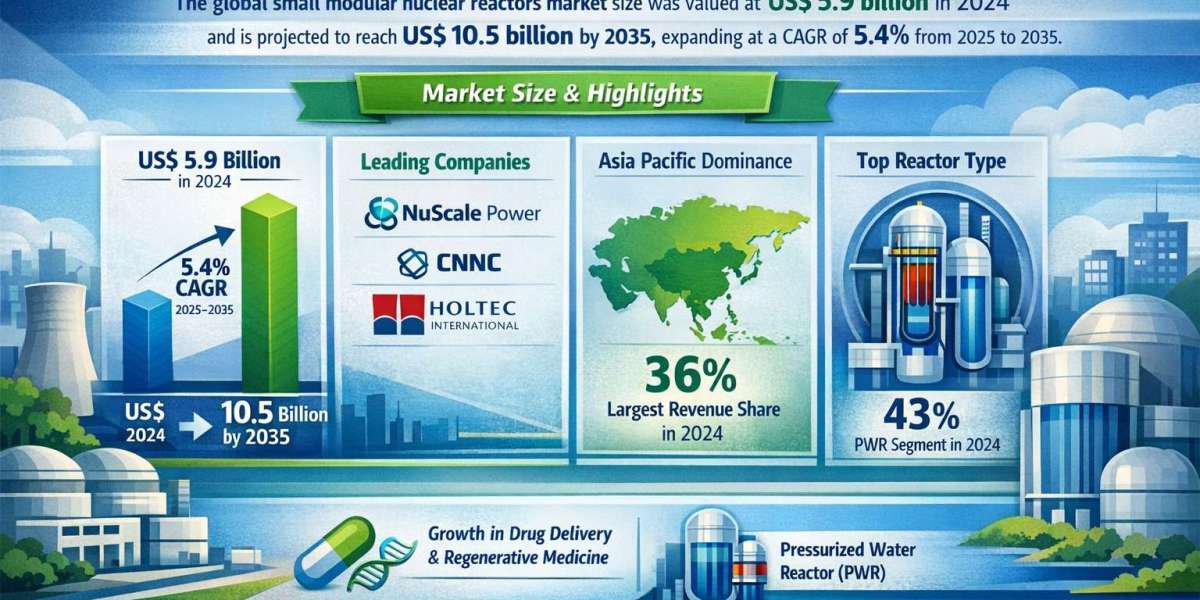

The global small modular nuclear reactors (SMNR) market is steadily emerging as a strategic pillar of the future low-carbon energy mix. Valued at US$ 5.9 billion in 2024, the market is projected to reach US$ 10.5 billion by 2035, expanding at a CAGR of 5.4% from 2025 to 2035. Growth is being fueled by ambitious decarbonization targets, the need for flexible and reliable baseload power, and increasing interest in non-electric applications such as hydrogen production, industrial heat, and desalination.
Market Size and Key Highlights
Small modular nuclear reactors are gaining traction as an alternative to large conventional nuclear plants. In 2024, the market reached US$ 5.9 billion, and it is expected to nearly double by 2035. The moderate but consistent growth rate reflects the capital-intensive and highly regulated nature of nuclear energy, balanced by strong long-term demand for clean, firm power.
Key industry participants such as NuScale Power, China National Nuclear Corporation (CNNC), and Holtec International are leading technology development and commercialization efforts. Regionally, Asia Pacific dominated the market in 2024 with a 36% revenue share, driven by rapid industrialization, rising electricity demand, and aggressive nuclear deployment plans in China and India. By reactor type, pressurized water reactors (PWRs) held the largest share at 43%, benefiting from proven technology, established supply chains, and regulatory familiarity.
Analysts’ Viewpoint: Gradual but Strategic Expansion
According to analysts, the SMNR market is expected to expand gradually rather than explosively, reflecting the careful pace of nuclear licensing, financing, and infrastructure development. However, the strategic importance of SMNRs is increasing rapidly. Governments and utilities are viewing them as a solution to three major challenges: deep decarbonization, grid reliability, and energy security.
The factory-built, modular design of SMNRs significantly reduces on-site construction complexity and capital risk compared to traditional gigawatt-scale nuclear plants. Regulatory streamlining, public-private partnerships, and government incentives are accelerating technology maturation and improving investor confidence. Vendors are prioritizing standardized designs, serialized manufacturing, and strong supply-chain partnerships to drive down costs and shorten deployment timelines.
While challenges remain—such as grid integration, skilled workforce availability, and long lead times for select components—harmonized licensing frameworks, investor guarantees, and local-content policies are helping mitigate these risks and support early deployments.
Small Modular Nuclear Reactors Market Overview
Small modular nuclear reactors are factory-fabricated nuclear units, typically generating up to 300 MW per reactor, designed for flexible deployment either as single units or in multi-module clusters. They leverage established nuclear fission principles while emphasizing simplified designs, enhanced passive safety systems, and modular construction.
SMNRs are well suited for distributed power generation, remote and off-grid locations, industrial process heat, hydrogen production, and desalination. Their ability to load-follow and complement intermittent renewable energy sources positions them as an effective backbone for renewable-heavy grids. Moreover, their compact footprint makes them viable replacements for aging coal plants using existing grid and industrial infrastructure.
Global Shift to Decarbonized Baseload Power Driving Demand
One of the strongest drivers of the SMNR market is the global shift toward decarbonized baseload electricity. While renewables such as solar and wind are expanding rapidly, they alone cannot provide 24/7 reliable power. SMNRs fill this gap by offering dispatchable, emission-free electricity with high capacity factors.
As industries electrify and adopt hydrogen, e-fuels, and carbon-free thermal energy, demand for stable clean power is accelerating. SMNRs provide reliable output with advanced load-following capabilities, enabling them to balance renewable variability effectively. They are also increasingly viewed as a practical replacement for retiring coal plants, particularly in regions seeking to decarbonize without compromising grid stability.
Additionally, SMNRs support energy security in remote regions, mining operations, island economies, and defense installations, reducing reliance on diesel generation and fossil fuel imports.
Lower Capital Risk Through Modular, Factory-Built Designs
A defining advantage of SMNRs is the reduction of capital risk enabled by factory-based modular manufacturing. Traditional nuclear projects often suffer from cost overruns and delays due to complex on-site construction. SMNRs shift much of this work to controlled factory environments, improving quality control and schedule predictability.
The ability to deploy reactors incrementally allows utilities to match capacity additions with demand growth, improving cash-flow management and reducing upfront financial exposure. Smaller initial investments also enhance bankability, making SMNR projects more attractive to lenders, export credit agencies, and institutional investors. For developing economies, this model makes nuclear energy more accessible without excessive public debt.
Pressurized Water Reactors Lead by Reactor Type
Among reactor technologies, pressurized water reactor (PWR)-based SMNRs dominate the market due to their proven operational history and well-understood regulatory pathways. Many vendors are adapting existing PWR designs into modular formats, accelerating commercialization and reducing licensing risk. These advantages make PWR-based SMNRs the preferred choice for early large-scale deployments.
Regional Outlook: Asia Pacific at the Forefront
Asia Pacific leads the global SMNR market, driven by massive electricity demand growth, urbanization, and decarbonization pressure. Countries such as China and India, among the world’s largest carbon emitters, are investing heavily in next-generation nuclear technologies to secure long-term clean energy supply. State backing, large domestic markets, and manufacturing scale give the region a strong advantage in early adoption and export potential.
Competitive Landscape and Recent Developments
The market is shaped by major players including NuScale Power, CNNC, Holtec International, Rolls-Royce plc, General Atomics, and Terrestrial Energy. Recent milestones include GE Hitachi’s BWRX-300 advancing toward commercial deployment, CNNC’s ACP100 (Linglong-One) reaching major construction milestones in China, and Rolls-Royce SMR securing strategic partnerships and government backing in the UK.
Outlook to 2035
Looking ahead, small modular nuclear reactors are set to play a critical long-term role in the global energy transition. While deployment will be gradual, the combination of decarbonization needs, flexible baseload demand, and reduced capital risk ensures sustained growth through 2035. As regulatory frameworks mature and early projects demonstrate success, SMNRs are expected to become a cornerstone of clean, secure, and resilient energy systems worldwide.


