
Report Overview
Sulphur hexafluoride (SF₆) is a synthetic, colourless, and non-flammable gas widely utilized in high- and medium-voltage electrical systems due to its superior insulating and arc-quenching capabilities. It is extensively used in gas-insulated switchgear, substations, circuit breakers, and transmission networks to support safe, reliable, and efficient electricity distribution. Despite its industrial significance, SF₆ is recognized as one of the most potent greenhouse gases, with a 100-year global warming potential nearly 24,300 times higher than CO₂.
Demand for SF₆ is strongly linked to the continuous expansion of global power infrastructure. Growing electrification, increasing electric vehicle adoption, expanding data center facilities, and rising cooling demand are significantly boosting electricity consumption worldwide. According to the International Energy Agency (IEA), global electricity demand grew by approximately 4.3% in 2024 and is expected to increase at an average annual rate of 3.9% through 2027. Developing Asia continues to emerge as a major growth region, where electricity access increased from 79% in 2010 to 97% in 2023, driving sustained investments in high-voltage transmission networks that traditionally rely on SF₆-based technologies.
Download a sample report for more detail in a minute:
https://market.us/report/global-sulfur-hexafluoride-market/request-sample/
Takeaways
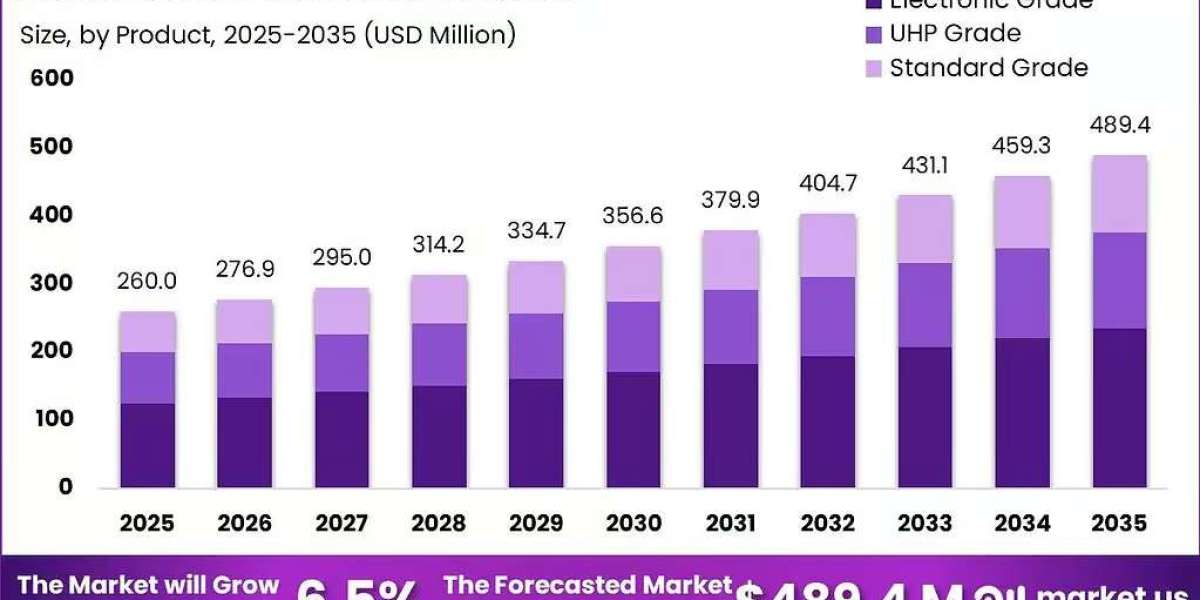
- The Global Sulphur Hexafluoride Market is expected to reach USD 489.4 Million by 2035 from USD 260.0 Million in 2025, growing at a CAGR of 6.5%.
- Electronic Grade accounted for more than 48.3% of the market share.
- Power & Energy emerged as the leading application segment with over 52.8% share.
- Asia Pacific dominated the market, representing 49.1% of global revenue, equal to nearly USD 127.6 Million.
By Product Analysis
Electronic Grade SF₆ led the market with a 48.3% share in 2024
In 2024, the Electronic Grade segment captured over 48.3% of the global sulphur hexafluoride market, mainly driven by expanding semiconductor manufacturing and rising production of advanced electronic devices. High-purity SF₆ is extensively used in plasma etching, chamber cleaning, and insulation applications within semiconductor fabrication facilities.
By Application Analysis
Power & Energy dominated with a 52.8% market share in 2024
The Power & Energy segment held more than 52.8% of the sulphur hexafluoride market in 2024. The segment's dominance was supported by the widespread use of SF₆ in high-voltage transmission systems, substations, circuit breakers, and gas-insulated switchgear (GIS).
Key Market Segments
By Product
- Electronic Grade
- UHP Grade
- Standard Grade
By Application
- Power & Energy
- Medical
- Metal Manufacturing
- Electronics
- Others
Emerging Trends
Shift toward SF₆-free and sustainable switchgear solutions
The Food and Agriculture Organization (FAO) estimates that agrifood systems generated nearly 16.2 billion tonnes of CO₂-equivalent emissions in 2022, accounting for around one-third of global greenhouse gas emissions. This has increased pressure on industries to adopt cleaner electrical technologies and reduce dependence on high-emission gases like SF₆.
Cold-chain infrastructure is also driving this shift. UNEP and FAO reported that nearly 526 million tonnes of food production are lost annually because of inadequate refrigeration systems, equal to about 12% of global food output. As refrigeration networks expand, demand for environmentally sustainable switchgear solutions is increasing.
Regulations are also tightening globally. The European Union's updated F-gas Regulation (EU 2024/573) will prohibit SF₆ use in new switchgear systems up to 24 kV from 2026, while systems between 24 kV and 52 kV will face restrictions starting in 2030.
Drivers
According to FAO, food production and distribution activities account for nearly 30% of global energy consumption and approximately 31% of worldwide greenhouse gas emissions. The growing need for efficient refrigeration and temperature-controlled logistics is increasing investments in high-voltage electrical infrastructure.
UNEP and FAO estimate that inadequate refrigeration causes annual losses of around 526 million tonnes of food, enough to feed nearly 1 billion people. To reduce these losses, governments and industries are rapidly investing in cold-storage facilities and refrigerated supply chains, indirectly supporting demand for SF₆-based transmission and distribution systems.
Restraints
Environmental concerns and stricter regulations limit SF₆ adoption
One of the major restraints in the sulphur hexafluoride market is its extremely high global warming potential. Although SF₆ offers excellent insulation performance, it is considered one of the most powerful greenhouse gases, leading to growing regulatory pressure worldwide.
Governments and environmental agencies are introducing stricter regulations to reduce SF₆ emissions and encourage the adoption of alternative technologies. The European Union's updated F-Gas regulations include phase-out plans for SF₆ in new electrical installations by around 2032, along with strict leak monitoring and reporting requirements.
Opportunity
FAO estimates that agrifood systems contributed nearly 16.2 billion tonnes of CO₂-equivalent emissions in 2022, highlighting the need for efficient and stable electrical systems. Expanding cold-chain infrastructure is becoming essential to reduce food losses and improve global food distribution efficiency.
According to UNEP and FAO, nearly 526 million tonnes of food production are lost annually because of inadequate refrigeration infrastructure. This is increasing investments in refrigerated logistics, cold-storage facilities, and modern electrical grids.