
Overview
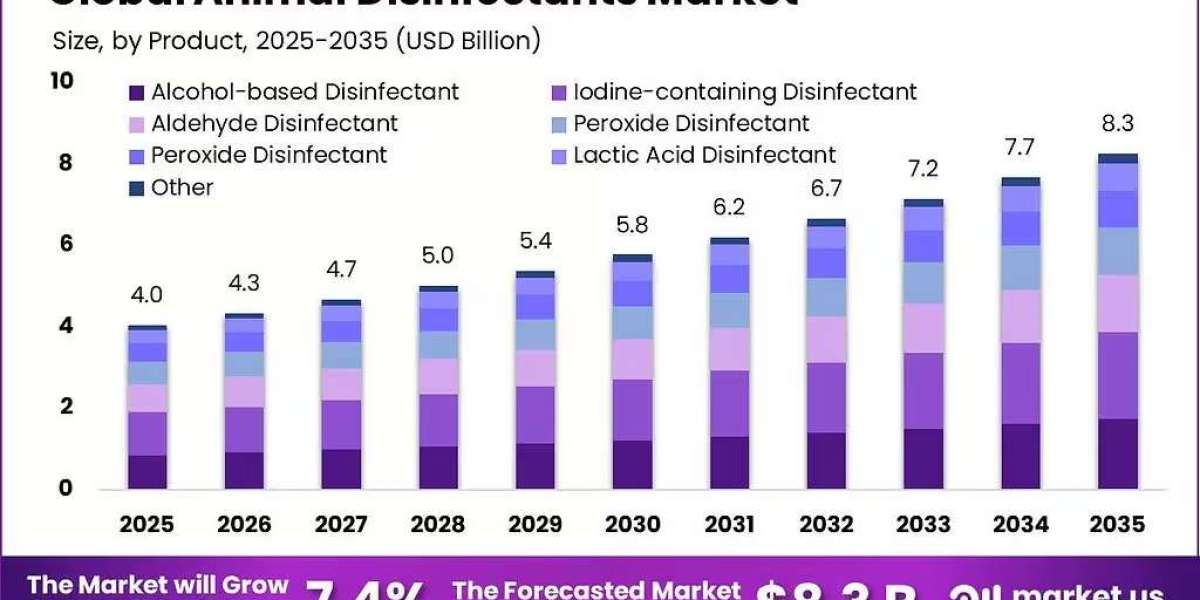
The Animal Disinfectants Market is expected to reach around USD 8.3 Billion by 2035 from USD 4.0 Billion in 2025, growing at a CAGR of 7.4% during 2026–2035. North America led the market with a 37.3% share, valued at nearly USD 1.4 Billion.
Animal disinfectants are widely used across livestock, poultry, dairy farms, and aquaculture facilities to control infections and maintain farm hygiene. Rising concerns over animal diseases, stricter food safety standards, and increasing biosecurity measures are driving market growth.
Government initiatives are further supporting demand. The U.S. Department of Agriculture introduced a USD 1 Billion program to control HPAI, while India’s NADCP continues to strengthen livestock disease prevention through large-scale vaccination programs.
To learn more about this report - https://market.us/report/animal-disinfectants-market/request-sample/
Key Takeaways
· The Animal Disinfectants Market is projected to reach around USD 8.3 Billion by 2035 from USD 4.0 Billion in 2025, growing at a CAGR of 7.4%.
· Iodine-containing disinfectants led the product segment with a 26.4% market share.
· Livestock animals accounted for the largest share at 72.8%.
· Liquid formulations dominated the market, holding a 69.1% share.
· Dairy farming emerged as the leading application segment with 36.7%.
· North America held a dominant 37.3% market share, valued at nearly USD 1.4 Billion.
By Product Analysis
Iodine-containing disinfectants dominated the market with a 26.4% share due to their strong effectiveness against bacteria, fungi, and viruses. Their wide use across livestock farms, poultry houses, dairy units, and veterinary clinics supported segment growth in 2024.
By Animal Type Analysis
Livestock animals accounted for 72.8% of the market, driven by increasing biosecurity needs across cattle, poultry, pigs, and other farm animals. Rising focus on infection prevention and farm sanitation boosted disinfectant usage in livestock operations.
By Form Analysis
Liquid disinfectants captured a leading 69.1% share because of their easy application through spraying, washing, dipping, and fogging methods. Their convenience and flexibility made them highly preferred in commercial farm sanitation practices.
By Application Analysis
Dairy farming held a dominant 36.7% market share due to strict hygiene standards in milk production. Disinfectants are extensively used for cleaning milking equipment, storage units, barns, and feeding areas to maintain product safety and animal health.
Key Market Segments
By Product
· Alcohol-based Disinfectants
· Iodine-based Disinfectants
· Aldehyde-based Disinfectants
· Peroxide Disinfectants
· Quaternary Ammonium Compound (QAC) Disinfectants
· Lactic Acid-based Disinfectants
· Other Disinfectant Types
By Animal Category
· Livestock Animals
· Companion Animals
By Form
· Liquid Formulations
· Powder Formulations
· Other Forms
By Application
· Dairy Farming
· Poultry Farms
· Aquaculture Facilities
· Swine Farms
· Equine Care
· Other Applications
Emerging Trends
Growing Focus on Biosecurity in Livestock Farming
Government initiatives to control outbreaks such as avian influenza, swine fever, and foot-and-mouth disease are further supporting the use of disinfectants in animal farming. In addition, large commercial dairy, poultry, and swine farms are implementing structured sanitation protocols for equipment, transport vehicles, animal housing areas, and worker entry points to maintain healthier farm environments and improve disease control.
Drivers
Rising Livestock Production and Disease Prevention Boost Disinfectant Demand
According to the Food and Agriculture Organization (FAO), global meat production reached 374 million tonnes in 2024, reflecting continued growth in livestock farming worldwide. As farm sizes increase, regular disinfection of barns, feeding areas, transport vehicles, and equipment has become essential to control disease outbreaks and maintain animal health.
The growing livestock population, especially in poultry farming, is further driving disinfectant demand. In addition, global efforts to reduce antimicrobial resistance (AMR) are encouraging preventive farm hygiene measures. The World Health Organization (WHO) reported that antimicrobial resistance directly caused 1.27 million deaths globally in 2019, highlighting the importance of stronger disease prevention and biosecurity practices.
Restraints
Strict Environmental and Safety Regulations Limiting Disinfectant Usage
One of the key restraints affecting the Animal Disinfectants Market is the growing enforcement of environmental and safety regulations related to chemical disinfectant usage in livestock farming. Although disinfectants are essential for controlling infections and maintaining farm hygiene, excessive or improper use may lead to water contamination, chemical residues, and environmental hazards.
Opportunity
Expanding Livestock Farming Creating Growth Opportunities for Disinfectants
According to the Food and Agriculture Organization (FAO), global meat production reached 374 million tonnes in 2024, reflecting strong growth in livestock production worldwide. As farm sizes and animal populations continue to increase, maintaining sanitation in barns, feeding areas, transport vehicles, and equipment has become essential to prevent disease outbreaks.